What is typia?
typia turns your TypeScript types into runtime code at compile time.
Other libraries make you write your types twice — once in TypeScript and once as a schema, decorators, or guards. typia reads the type you already wrote and emits the validator, JSON serializer, schema, or decoder for you. One line, pure types, no duplication.
Here it is in action — on the left is the source you write, on the right is what typia generates for you at compile time:
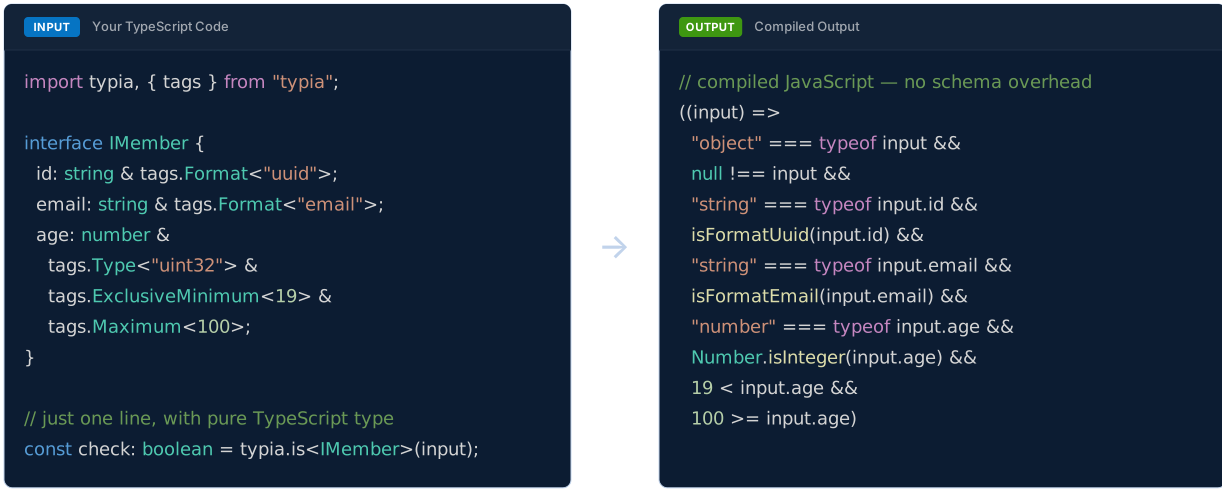
No reflection at runtime, no schema file to maintain — just the exact comparisons your IMember type implies, inlined into the build. This is the core trick that every other typia feature builds on; see Pure TypeScript for the long story.
The right-hand “Compiled Output” is produced by typia’s compile-time transform — stock
tscwill not produce it. To enable the transform, install the TypeScript 7 toolchain in Setup and build withttsc,ttsx, or@ttsc/unplugin. Without setup, yourtypia.is<T>()call sites throw at runtime instead.






API surface
typia covers five feature areas, all driven by the same TypeScript-type-to-runtime-code transform:
- Super-fast runtime validators —
is/assert/validate(+ Equals strict variants) - Enhanced JSON — type-safe
assertParse, much fasterassertStringify, OpenAPI / JSON Schema generation - LLM function calling harness — class → tool schemas with lenient JSON parsing, type coercion, and validation feedback baked in
- Protocol Buffer codec — encode / decode +
.prototext emission from a TypeScript type - Random data generator — produce a value that satisfies the type, tags and all
// Runtime validators — write a type, get a checker
typia.is<T>(input); // boolean
typia.assert<T>(input); // throws TypeGuardError, otherwise returns input
typia.assertGuard<T>(input); // narrows the variable (`asserts input is T`)
typia.validate<T>(input); // returns IValidation<T> with every error path

// JSON — same idea, plus performance
typia.json.assertParse<T>(text); // safe JSON.parse + assert
typia.json.assertStringify<T>(obj); // ~10x faster JSON.stringify with type safety
typia.json.schemas<[T]>(); // emit OpenAPI/JSON Schema

// LLM function calling — turn a TypeScript class into tools
typia.llm.application<MyService>(); // full ILlmApplication with parse/coerce/validate
typia.llm.structuredOutput<T>(); // schema + parser + coercer + validator
typia.llm.evaluation<T>(); // evaluation-model questions + checked answer decoder
typia.llm.parameters<T>(); // just the JSON schema

// Protocol Buffer — same again, in binary
typia.protobuf.assertEncode<T>(obj);
typia.protobuf.assertDecode<T>(bytes);
typia.protobuf.message<T>(); // emit .proto schema text

// Test data
typia.random<T>(); // generate a value that satisfies T
Only one line required, with pure TypeScript types
Runtime validator up to 20,000× faster than class-validator
(benchmark )
JSON serialization up to 200× faster than class-transformer
(benchmark )
LLM function calling success rate: 6.75% → 100% with the typia harness (story )
Build setup
The transformation above happens at compile time, so typia needs to be wired into the TypeScript build. Use ttsc for TypeScript 7 builds, ttsx when running a TypeScript entrypoint directly, and @ttsc/unplugin for bundlers such as Vite, Next.js, Webpack, esbuild, Rollup, and Bun.
Whichever path you pick, the call sites in your code don’t change —
typia.is<T>,typia.assert<T>,typia.json.assertParse<T>, … always emit the same inline checks shown in What is typia? above. Setup is something you do once; the rest of the docs assume it’s done.
Where to go next
- Need to install it now? See Setup for the TypeScript 7
ttsctoolchain. - Looking up an API? Jump straight to Validators, JSON, LLM, Protobuf, or Random.
- Building an agent? Start at LLM function calling and the function calling harness.
- Adopting on NestJS / Hono / tRPC? See the Utilization Cases — drop-in recipes for the most common backend frameworks.
Sponsors

If typia saves you time, please consider donating to the project .
References
- Inspired by
typescript-is - Source code: github.com/samchon/typia
- Playground: typia.io/playground
- Benchmarks: benchmark/results